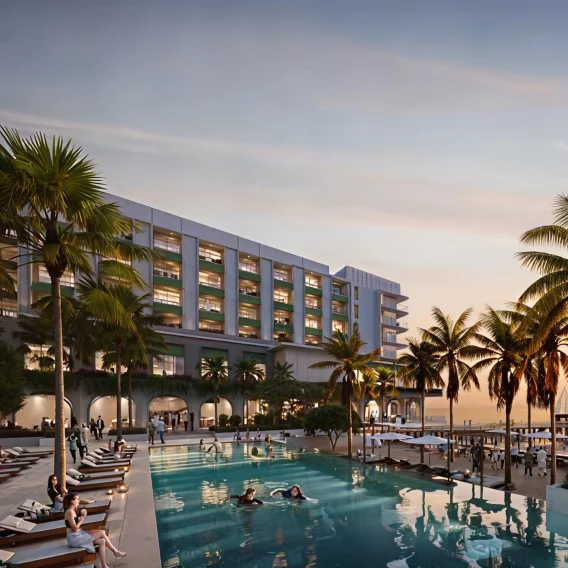
Sofitel La Corniche
Sofitel La Corniche is a landmark 130-key luxury hotel and mixed-use development planned for Moroni. The 42,000 m2 scheme will combine the hotel with retail, a supermarket and entertainment facilities, bringing new hospitality and commercial uses to the Comorian capital.
Ascentis was engaged by the owner to support the development of a hotel in a market with no established supply in the target segment. We began the engagement with a detailed feasibility study and has continued across project, design, cost, tender, procurement and construction management.
Project Objectives
- Establish a viable luxury positioning based on realistic demand and room rate potential
- Define the appropriate room mix, key count and facilities for the market and owner
- Translate the product strategy into an efficient, owner-aligned area programme
- Control capital expenditure through early cost planning, BIM coordination and procurement input
- Target LEED Gold and reduce embodied carbon below 500 kg CO2e/m2
Challenges
- Establishing a new luxury market
Moroni has no luxury hospitality supply and market benchmarks. The feasibility study needed to establish credible demand and room rate potential while remaining aligned with the owner’s ambition for an internationally branded luxury hotel. - Balancing the product, space and cost
The room mix, key count and facilities had to support the guest experience and efficient hotel operations within a viable area programme and target cost. The wider scheme also combines hotel, retail, supermarket and entertainment uses within one coordinated development. - Meeting programme and sustainability targets
The fast-track programme requires early design decisions and close coordination across an international team. At the same time, the project is targeting LEED Gold, solar power and an embodied carbon intensity below 500 kg CO2e/m2 in a market with supply chain constraints. - Procurement in an import-heavy market
Comoros imports nearly all construction materials, including MEP systems, lifts, façade elements, and waterproofing products. As a result, the procurement strategy had to progress in parallel with design. For Sofitel Moroni, we developed a logistics-driven procurement plan that identified all long-lead systems early. This was not about increasing complexity—it was about establishing predictability in a context where even small delays can escalate quickly.
Achievements to Date
- Feasibility-led development strategy
The market assessment established realistic room rate potential and informed the positioning, room mix, key count and facilities. It supported SGIAC Comores in securing a prime government plot and progressing the partnership with Accor. - BIM-led design coordination
A coordinated BIM environment brings together architecture, structure, building services, interiors and landscape design. This allows the team to resolve clashes early, improve quantity information and reduce the risk of site changes, rework and material waste. - Lower-carbon design
A Life Cycle Assessment identified concrete and steel as more than 80% of the baseline design’s embodied carbon. We adopted a Post-Tensioned (PT) slab system—a first in Comoros—to accelerate construction and significantly reduce steel and concrete quantities compared to a conventional reinforced slab. The use of Portland Slag Cement with 45% GGBS and high-recycled-content steel reduced the modelled global warming potential from 687 to 368.8 kg CO2e/m2. The combined strategy indicated a 46% carbon reduction and nearly 12% lower material costs. - Award winning design
Designed by Andy Fisher Workshop, the hotel has won two prestigious design awards to date.- In 2024, the hotel was awarded the Architectural Design Hotel – Luxury prize at the Liv Hospitality Design Awards which recognizes excellence in hospitality architecture, interior design, and guest experience, on a global scale.
- In 2026, the project was recognized at the African International Design Awards (AIDA) in the Hospitality Architecture category.
Sofitel La Corniche shows how early feasibility, an owner-aligned brief and disciplined project controls can guide a complex hospitality development from investment concept through design and delivery. The project has established a viable luxury product, secured an international operator and embedded measurable cost and sustainability targets into the design. Once complete, it will introduce a new standard of luxury hospitality in Moroni and become a prominent addition to the city’s waterfront.