
Building Certainty in Emerging Markets
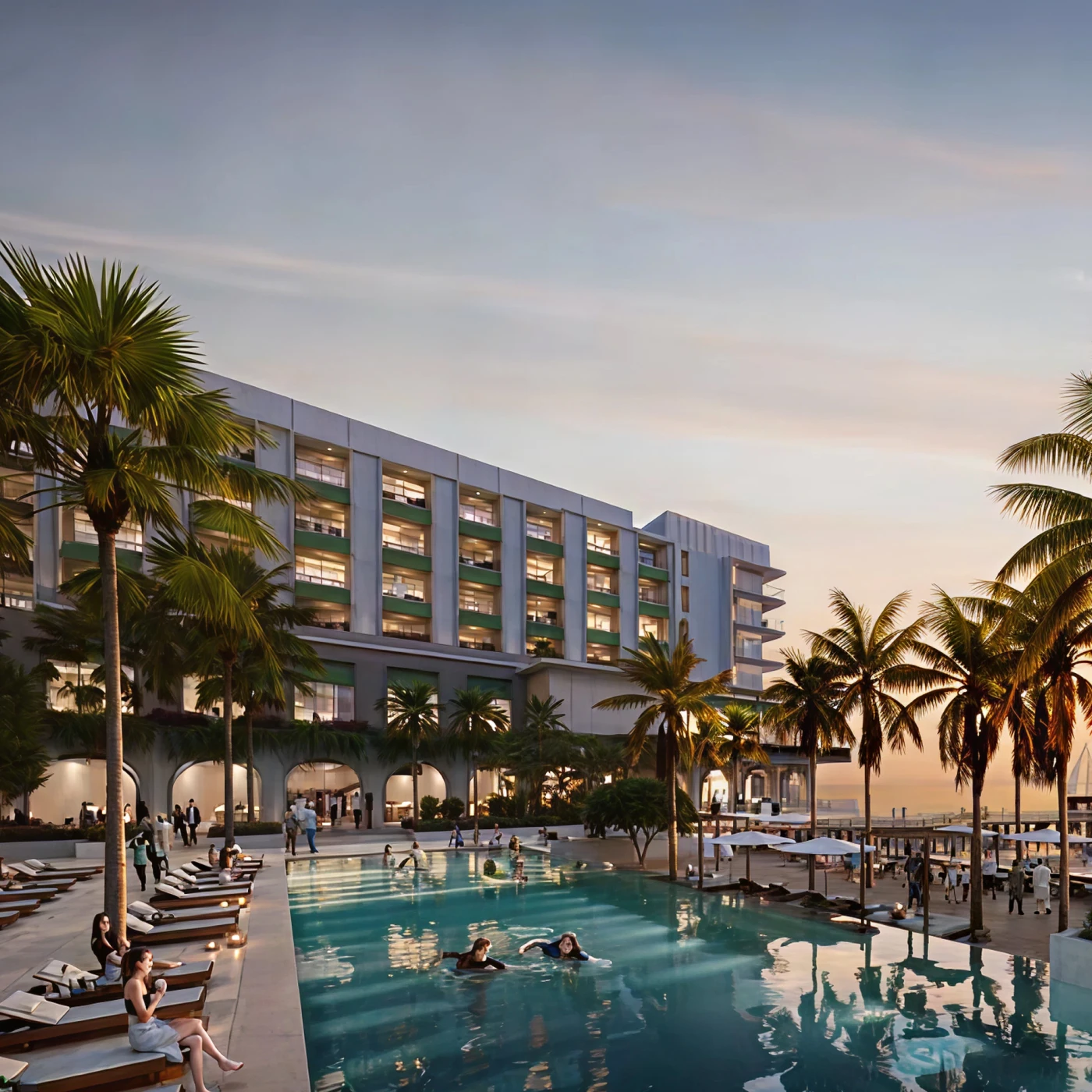
When it opens in 2028, Sofitel La Corniche in Moroni will be the largest mixed-use development in Comoros. The project spans 42,000 m² and includes a 130-key oceanfront hotel together with retail, wellness, dining, and event facilities. While its scale is significant, what truly defines this development is its location.
Delivering a 5-star asset in an emerging market requires more than technical expertise alone. These environments often lack mature supply chains, established contracting ecosystems, and readily available specialist skills. In such contexts, the design-to-tender phase becomes the most decisive stage of the project lifecycle. It is where risks are anticipated and resolved early—before the first cubic meter of concrete is poured.
Turning constraints into certainty
The site sits on coastal lava rock with strong tidal variations and continuous chloride exposure typical of an XS3 marine environment*. These conditions shaped the project’s foundation strategy, corrosion protection approach, waterproofing design, and overall structural system selection.
We adopted a Post-Tensioned (PT) slab system—a first in Comoros—to accelerate construction and significantly reduce steel and concrete quantities compared to a conventional reinforced slab. PT typically reduces slab thickness by 20–35%, leading to substantial savings in both rebar tonnage and concrete volume. This material efficiency directly reduces the project’s overall carbon footprint by lowering cement and steel use and minimizing transport demand.
This approach also shortens the construction cycle and improves buildability—critical advantages on an island with limited resources and long import lead times.
Concrete specifications were adjusted for the marine environment through the use of chloride-resistant cement compositions and detailing aligned with XS3 durability requirements, ensuring long-term structural performance in a harsh coastal climate.
To enable this strategy, the design team resolved all architectural, structural, and MEP interfaces well before tender. In markets where material reorders can take weeks, precision is not optional—it is the only path to certainty.
(*) XS3: “severe marine exposure,” where concrete is continuously attacked by saltwater—demanding the highest durability measures.
Managing quality when experience is scarce
With limited local technical expertise, Ascentis engaged international specialist consultants and implemented a rigorously structured design process. Formal reviews and sign-offs were conducted at each stage—Concept, Schematic, Design Development, and Tender—to maintain clarity and ensure that all disciplines advanced in alignment.
Extensive use of BIM and Navisworks enabled clash detection, accurate quantity validation, and coordinated design development. A shared data environment ensured strict document control and weekly progress logs, supporting seamless collaboration across multiple countries and time zones.
Operator alignment with Accor was managed through scheduled reviews and version-controlled submissions, ensuring all stakeholders worked from a unified set of documents.
In markets like Comoros, informal coordination is insufficient. Leadership must be intentional, structured, and continuous.
Planning procurement in an import-heavy market
Comoros imports nearly all construction materials, including MEP systems, lifts, façade elements, and waterproofing products. As a result, the procurement strategy had to progress in parallel with design.
For Sofitel Moroni, we developed a logistics-driven procurement plan that identified all long-lead systems early. This was not about increasing complexity—it was about establishing predictability in a context where even small delays can escalate quickly.
Engineering for longevity and maintainability
In markets with limited maintenance capacity, durability takes precedence over flexibility.
MEP systems were selected for reliability, resilience, and ease of upkeep. Materials and finishes were evaluated based on life-cycle performance rather than appearance or initial cost alone. These decisions also supported the project’s ambition of achieving LEED Gold certification, the first in the country.
But the objective extended beyond certification. The aim was to deliver a building that maintains performance, efficiency, and safety for decades in a demanding marine climate.
My five key takeaways
Delivering a 5-star asset in a developing market demands rigour, foresight, and adaptability.
From Sofitel Moroni, several lessons stand out:
- De-risk the project early
Early studies guided critical decisions on levels, foundations, waterproofing, corrosion protection, marine exposure, and structural strategy—reducing downstream uncertainty. - Prioritise simplicity for longevity
Complex systems are more likely to fail when maintenance capacity is limited. We focused on systems that are durable, standardised, and easy to operate. This approach extends the asset’s useful life and reduces long-term costs. - Develop procurement plans alongside design
In import-dependent markets, procurement cannot wait for design completion. Early engagement with suppliers ensured realistic lead times and prevented any future programme delays. - Build accountability into every stage
Structured reviews, shared platforms, and strict revision control eliminated scope gaps and kept documentation fully coordinated. - Lead with coordination, not assumptions
Effective collaboration does not happen automatically. Frequent alignment workshops with architects, interior designers, engineers, and the operator prevented conflicts and ensured design practicality while maintaining brand standards.
Emerging markets offer tremendous opportunities, but they also test every aspect of project delivery.
When systems, materials, and even technical expertise must come from abroad, certainty must be engineered from the outset.
The Sofitel Moroni has shown that with the right planning, coordination, and commitment to quality, even the most complex projects can be executed to world-class standards, no matter where they are built.